Every market has its own dialect of doing business.
DealDialect is a free, research-based platform that helps U.S. small businesses communicate with partners in African markets. We start with Nigeria.
Our mission
Help American small businesses build trusted, lasting partnerships abroad by closing the communication gaps that quietly cost them deals.
Why we built DealDialect
Small and medium-sized businesses are the backbone of American exporting. In 2024, 97.1% of identified U.S. exporters were SMEs (U.S. Census Bureau). Most of them have no international department. The owner or one sales manager handles a foreign deal alone.
In a market like Nigeria, English is the official language, so the gap is easy to miss. The words are familiar, but the rules of the conversation differ. A missing greeting, a first name used too early or a polite "we will look into it" can change how a deal unfolds. Nobody tells you, and the deal goes quiet.
We believe this is a skill, not a mystery. Linguists can describe how business communication works in a market, clearly and respectfully. DealDialect turns that knowledge into short guides, practice tools and free workshops you can use before your next call or email.
Meet the founder
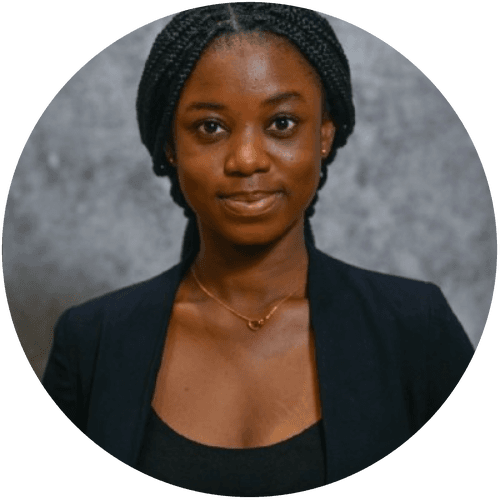
Ayomide Adeyeye, Founder
Ayomide Adeyeye is a sociolinguist. Ayomide holds an M.A. in English, with a concentration in Linguistics, from North Carolina State University. Ayomide's research focuses on Nigerian English and Nigerian Pidgin, and on how they shape everyday and business communication.
Ayomide founded DealDialect to turn that research into practical tools for U.S. exporters. She has more than five years of experience in training and business communication, including customer communication in Nigerian banking, communication consulting for small businesses, and corporate training. At NC State she taught first-year writing as a graduate teaching assistant, served as a Language Diversity Ambassador with the Linguistics Program, and presented research at the Southeastern Conference on Linguistics (SECOL) in 2024. She also holds a B.A. in Linguistics from Adekunle Ajasin University, Nigeria.
How we build our content
Every guide, lesson and template follows the same seven steps. Here is what each one means for you.
We start with your problems. We survey and interview U.S. business owners and export counselors to learn where communication goes wrong for them.
We study real conversations. With permission, and with names removed, we analyze real emails, proposals and meeting notes between U.S. firms and their partners. This shows where misunderstandings actually happen.
We use proven frameworks. We draw on sociolinguistics: discourse analysis, politeness theory, and research on world Englishes and Nigerian English. We also use well-known models of cross-cultural communication, such as Hall's high- and low-context communication and Hofstede's cultural dimensions.
People in the market check our work. Every market guide is reviewed by at least two business practitioners who work in that market before we publish it.
We design for busy adults. Lessons are short, use real scenarios and plain language, and meet WCAG 2.1 AA accessibility standards.
We test, then fix. Pilot firms and partner organizations try new material first. We revise it based on what they tell us.
We review every year. Each guide is reviewed annually. The date of the last review is shown at the top of the page.
Version 1 was written by Ayomide from her research on Nigerian English and Nigerian Pidgin, her professional experience and published sources. From the first review cycle, every update goes through all seven steps, and each page shows when it was last reviewed.
Our reviewer panel
Our reviewers are business practitioners who work in each market. They read every guide before it goes live and tell us what we got wrong. We list reviewers here only with their permission.
Want to review? If you do business in one of our markets, or advise U.S. exporters, we would value your eyes on our guides.
Independent and open
Our core content is free for every user. There are no paywalls, no ads and no sale of user data. Paid custom services for individual companies help fund the free platform.
Our guides, lessons, templates and workshop kits are openly licensed under Creative Commons Attribution 4.0 (CC BY 4.0). Anyone can use, adapt and share them, as long as they credit DealDialect.
DealDialect is an independent project created and owned by its founder, Ayomide Adeyeye. It is not tied to any employer, and it is not a government agency. Partner organizations help us reach businesses, but they do not control what we publish.
Questions, corrections or ideas? We would like to hear them.
Whether you run a small export business, advise exporters or teach international business, your experience makes DealDialect better.